
COLLECTIONS NOTE
Before a Historic Revolver Travels: The Museum Loan Record That Moves With It
A loan is not a shipping event with paperwork attached. It is a documented chain that keeps one historical object identifiable, comparable and accountable before departure, at every handoff and after return.
In a collections preparation room, two people may appear to be closing a fitted case around a historic revolver. The important work, however, is happening across several records at once. A current photograph identifies the object. A condition note fixes what was visible before movement. The case and its supports are documented. The receiving institution knows what it is accepting, and the returning institution knows what must be compared. If any one of those links is missing, a safe arrival can still leave a weak historical record.
Identity and condition travel together
The Library of Congress loan procedure asks for a complete object description, its collection location or catalog identifier, an identifying image when possible, and proposed shipping and insurance provisions. That combination matters. The request defines the exact object and destination; the inventory fixes its identity; the condition record gives both institutions a common point of comparison.
For a historic revolver, the identifying packet should describe the whole collection object rather than a fashionable type name. The catalog number, maker attribution as currently recorded, dimensions, material description and visible distinguishing features belong together. A photograph of the complete object should match the orientation used in the written record. Close views may clarify marks or wear, but they do not replace the overall view that proves which object the detail belongs to.
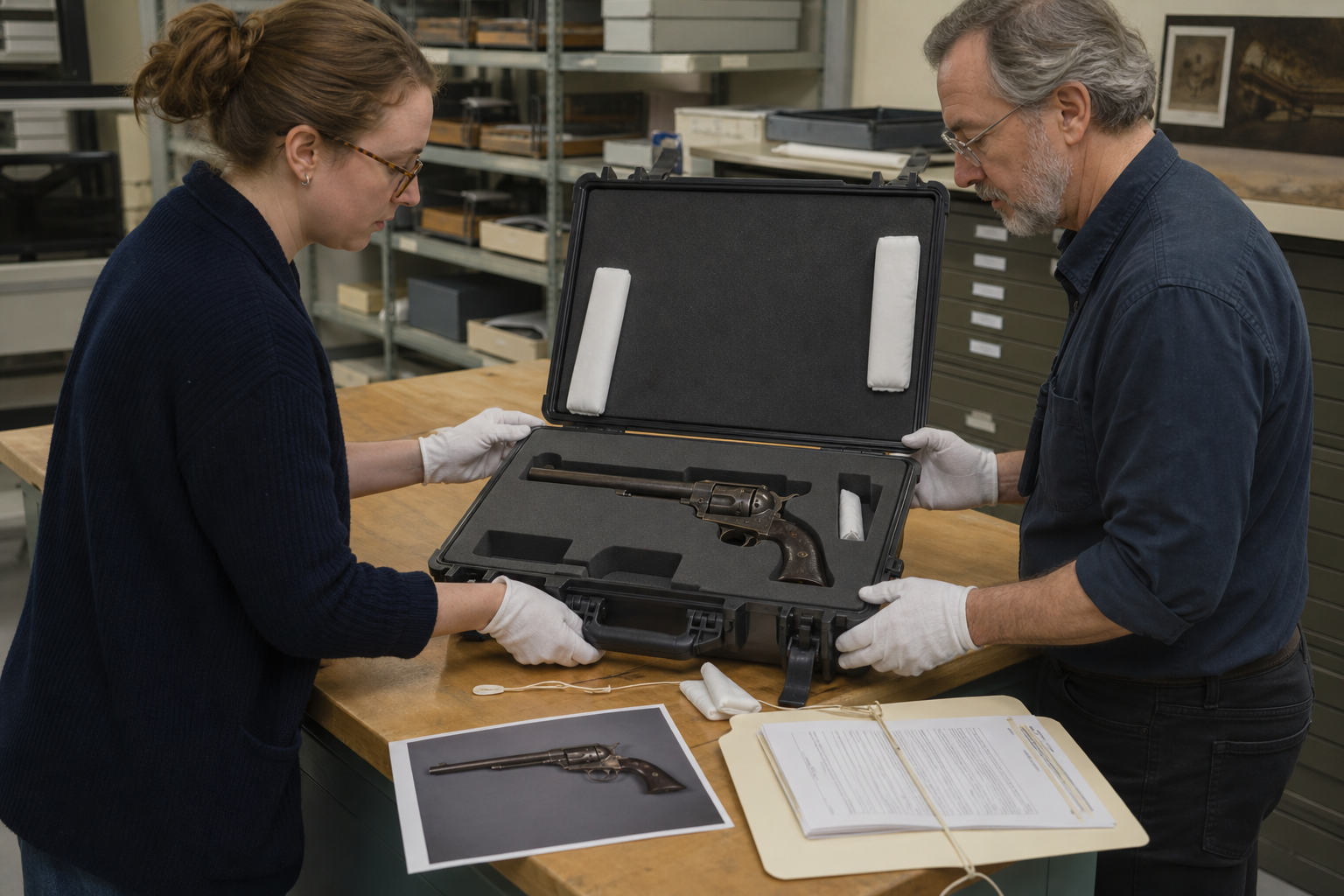
The condition statement stays observational. It records a scratch, a loose label, a discolored surface or a changed attachment without inventing a cause. The date, photographer and record version are retained. When a later image looks different, staff can then ask whether the object changed, the lighting changed or the viewing angle simply made an old feature more visible.
The case becomes part of the evidence
A transport case is not merely a black box between two buildings. Its internal support, object orientation and closure state explain how the item was held during movement. The Canadian Conservation Institute’s bulletin on effective packaging and transport separates hazards such as impact, vibration, abrasion and distortion. A loan record does not need to reproduce the engineering manual, but it should state which vulnerabilities were considered and which support arrangement was approved.
The wide packing photograph therefore has a precise job. It shows the full object resting in its fitted support, the case open, the support surfaces visible and the condition image nearby. A second photograph can record the closed case and its unique loan reference. These views document a relationship; they are not decorative images of an impressive container.
Changes to the packing arrangement receive a new note rather than quietly replacing the departure record. If the receiving team improves a support or uses a different closure, the reason, date and responsible institution remain visible. On return, the original and revised arrangements can be compared without guessing which photograph came first.
Custody changes at named moments
The Smithsonian Archives of American Art loan information places condition reporting and packing alongside shipping, insurance and conservation responsibilities. Those linked obligations turn a general exhibition request into a traceable movement of a specific collection item rather than a parcel with an impressive destination.
Each handoff should answer the same small set of questions: who released the case, who accepted it, when and where that happened, what identifier was checked, and whether the closure and exterior condition matched the record. A name without a time is incomplete; a time without the object or case identifier may describe the wrong transfer. The entries do not need dramatic prose. They need enough precision for another registrar to reconstruct the route.
Receipt is also a condition event. The receiving institution compares the case and object with the departure records before the loan disappears into exhibition preparation. Any discrepancy is described and photographed while the handoff is still current. That practice protects both institutions and, more importantly, prevents later uncertainty from becoming part of the object’s history.
The return comparison closes the record
A return does not simply reverse the outbound journey. The object is checked against the same overall views, detailed condition photographs and identifying fields created before departure. Similar camera position and lighting make comparison easier, but the new images remain dated return records rather than replacements for the originals.
The case record is reconciled as well. Staff confirm that the expected supports and associated documents came back, and they retain any notes created by the borrower. If something changed, the record separates a confirmed observation from an explanation that still requires review. The chain is strongest when it shows uncertainty honestly instead of forcing every difference into a confident story.
Finally, the agreement, inventory, condition versions, packing views, receipts and correspondence are kept under one loan identifier with links back to the museum catalog record. The object’s public history may focus on maker, date and craftsmanship. The internal loan file preserves another history: where the object went, who was responsible for it, what was observed and how the institution knows that the same documented object returned.
A well-built loan record therefore moves with the revolver even when the paper and image files travel separately. It keeps identity, condition, packaging and custody aligned from the first approved request to the final comparison. That continuity—not the mere fact that a case arrived—is what makes the loan defensible years later.
Published August 30, 2026.