
VISUAL HISTORY NOTE
Reading an Old Gunsmith Shop Photograph Without Overclaiming
A bench, a wall of tools and a single-action revolver can make an old workshop photograph feel self-explanatory. It is not. The useful history begins when visible detail is kept separate from the story a researcher hopes it tells.
The print on the archive table invites a quick conclusion: this was one maker's working shop, these were his tools and the revolver on the bench was the job of the day. A careful reader slows that sentence down. The picture certainly shows a room, tools, a bench and an intact revolver. It does not, by itself, identify the room, prove ownership of every object, date the scene or explain why the camera was there.
What the frame can prove
The National Archives photograph-analysis guide begins with a plain separation of people, objects and activity. That discipline suits a shop image. Count the people before assigning jobs. Note where tools hang and which surfaces are in use. Record whether the revolver is being held, resting on the bench or simply included at the edge. The first description should remain understandable even if every name and date later changes.
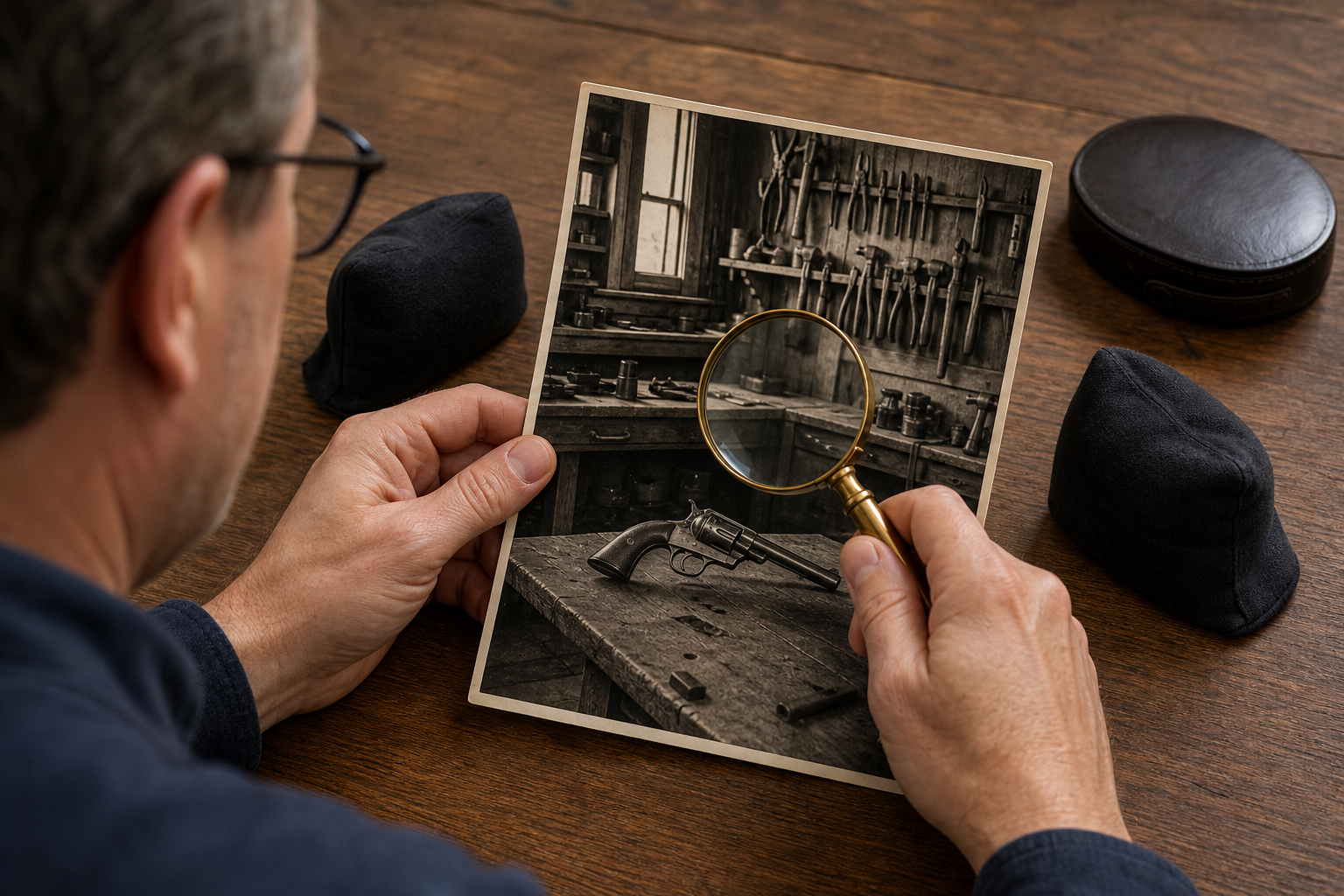
That is the action shown above. The researcher uses a magnifier on the complete print instead of extracting a dramatic detail and losing its surroundings. The tool wall, window, bench and revolver remain in one frame. Each clue keeps a location. A mark near the trigger guard, for example, should not be described without retaining the full-object view that shows where it appears.
Composition is evidence too. A cleared central bench, evenly arranged tools or a revolver turned toward the camera may mean the scene was prepared. They may also reflect normal work habits. The Library of Congress guidance on researching historical images asks readers to consider the maker, subject, process and intended purpose. A family keepsake, newspaper illustration, insurance view and trade advertisement can show the same room while emphasizing different facts.
What must be checked outside the frame
Look again at the print under the magnifier. The high camera position includes both bench and tool wall, while the revolver is clear in the foreground. That arrangement may present craftsmanship, but it does not prove a particular service or customer. The photograph supports a statement about presentation: the object was placed where the camera recorded it clearly. A claim about the business needs a dated caption, publication context, studio record or other independent evidence.
The National Archives Catalog search guidance treats dates and creators as distinct ways to narrow a record search. A shop photograph can use a visible clue in the same bounded way. A cataloged tool design, a dated wall calendar, a trade poster or a known building alteration may establish a useful search range or possible creator. None automatically proves the exact day the shutter opened.
The complete print therefore matters more than a crop of the revolver. Window shape can be compared with a known address. A tool or lamp may be checked against a dated catalog. A storefront view, city directory or newspaper notice may connect the room to a business name. These are separate comparisons, and each should be cited beside the claim it actually supports.
Conflicts are productive. If the room matches a documented address but one object appears later than the proposed date, the caption should preserve the disagreement. The object may have been misidentified, the print may be a later copy, or the address may have housed more than one shop. The next research question is more valuable than a falsely exact year.
A responsible final caption can be modest: an unidentified or tentatively identified gunsmith workshop, an approximate date range, visible features, source of the print and records used for comparison. What remains unknown belongs in the file as clearly as what has been established.
The old shop photograph is not a time machine. It is a bounded piece of evidence. Read it closely, keep observation apart from inference and let outside records carry only the claims they can support. That preserves the real historical value of the bench, tools and revolver without making the frame say more than it contains.
Published August 31, 2026.