
JAMES & GUNS FIELD NOTE · AUGUST 29, 2026
From Object to Record: Documenting a Historic Single-Action Revolver
A convincing history is not the longest story attached to an old revolver. It is the record that shows which details were observed, which came from a document, and which still need to be verified.
A historic single-action revolver may arrive with a family name, a faded photograph, a receipt, or only a sentence repeated for decades. Those clues matter, but they do not carry the same weight. The useful work is to preserve each clue, label its source, and resist turning uncertainty into fact. The Smithsonian describes provenance as the history of who owned an object from its creation to the present, while noting that incomplete histories are more common than complete ones.
This field note is about records, not handling or repair. Any physical examination belongs within the established safety procedures of a qualified museum professional, dealer, or gunsmith. Nothing needs to be operated, disassembled, cleaned, or altered to begin building a responsible file.
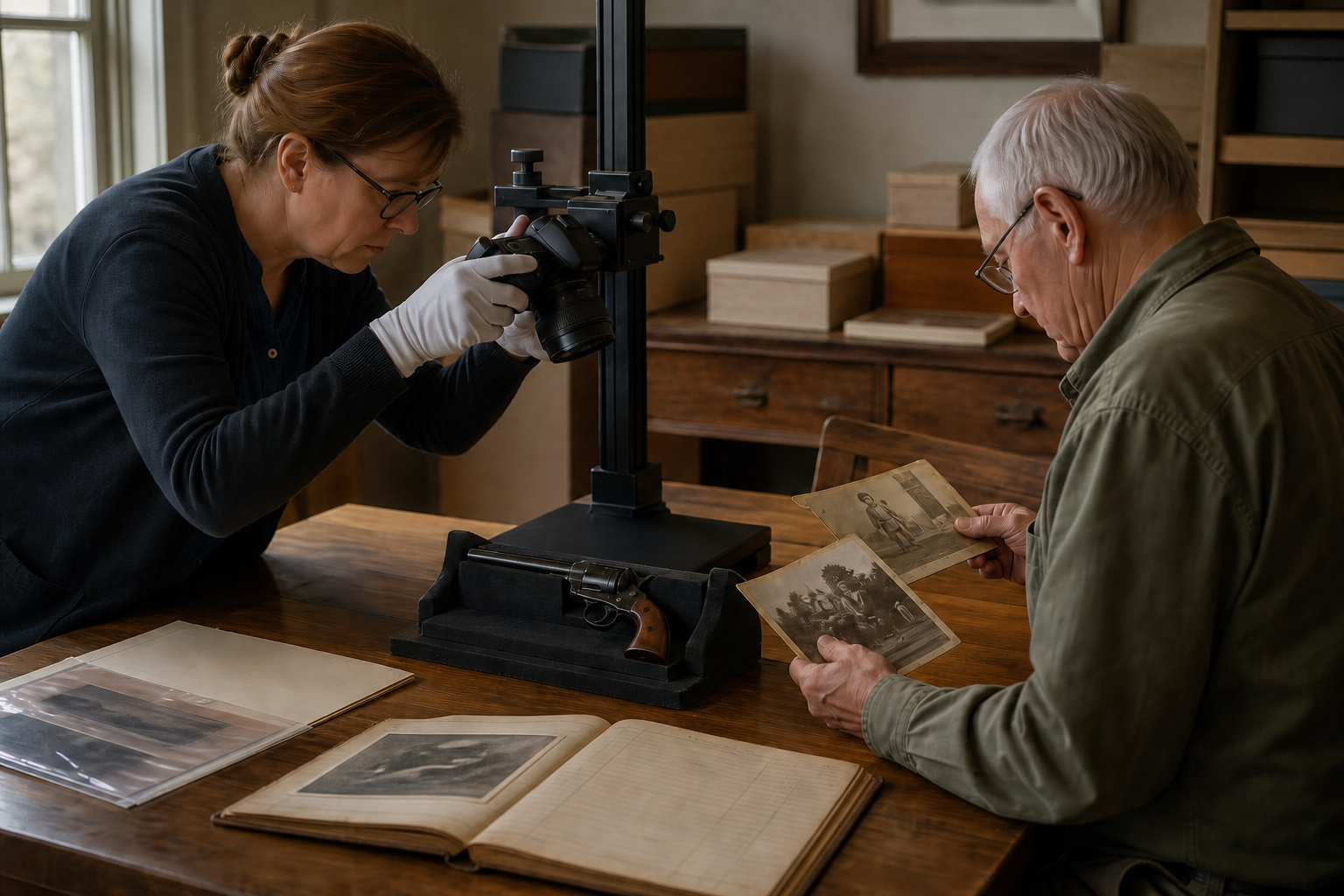
Begin with what the object can actually show
The first record should be descriptive rather than interpretive. Note the maker and model markings that are plainly visible, materials and finish, overall dimensions, identifying numbers, accessories that arrived with the object, and its present condition. Photograph the whole object and then the visible marks that support the description. A neutral background, consistent light and a scale card make later comparisons easier.
Do not improve the evidence before recording it. A worn surface, mismatched box, old label or repair note may be part of the history. If a feature cannot be seen without manipulation, leave it outside the observation sheet and refer the question to a qualified specialist. The aim is a dated snapshot of the object as received, not a verdict about originality or value.
Keep fact, attribution and family memory apart
Many weak histories fail because a plausible story is repeated until it sounds documented. A stronger file uses three labels consistently:
- Observed
- A detail visible on the object or in a document held with it.
- Attributed
- A conclusion made by a named specialist, catalogue or institutional source, with the date and source recorded.
- Reported
- A family or owner account that may be valuable but has not yet been independently confirmed.
Use plain phrases such as “reported by the previous custodian” or “date unresolved.” They do not weaken the record; they show where its boundaries are. Preserve the exact wording of a letter or caption in a transcription, but keep the scan or photograph beside it so another reader can return to the original evidence.
Make the ownership chain readable
A provenance timeline works best when each change of custody has its own entry. Record the known date or date range, the person or organization involved, the type of event, and the source that supports it. A sale receipt, dated photograph, insurance schedule, estate inventory, correspondence, exhibition label or service invoice can anchor an entry. When dates conflict, keep both claims and explain the conflict instead of silently choosing one.
The National Park Service Museum Handbook on museum records separates accessioning, cataloging, inventory, accountability and photography. A private family file does not need museum software, but the same separation is useful: one object record describes the item, one timeline describes custody, and one source register tells the reader where every claim came from.
Give each source a simple identifier and cite that identifier in the timeline. That small discipline prevents a detached photograph or undated note from becoming an unsupported conclusion. It also lets a curator, historian or specialist see quickly which parts of the chain are documented and which remain open research questions.
Preserve the source, not just the conclusion
Scan or photograph both sides of papers and photographs when the reverse carries captions, stamps or handling marks. Keep the original arrangement long enough to record which items were found together. File names can carry a source identifier, an approximate date and a view number without making claims the source cannot support.
The U.S. National Archives guidance for digitizing family papers and photographs recommends keeping the originals, adding basic who-what-where-when metadata, and backing up digital files. A scan is an access copy, not a replacement for the paper. Store the digital master separately from resized sharing copies, and keep a short log when names, dates or descriptions are corrected.
Physical records deserve the same restraint. Remove active hazards only with appropriate conservation advice; otherwise use stable folders or sleeves, avoid pressure-sensitive tape, and protect documents from light, damp and unnecessary handling. The record should survive even if the story is revised later.
A file the next custodian can understand
The finished package does not have to settle every question. It should contain a dated object record, a small set of clear photographs, a source-labeled ownership timeline, copies of supporting documents, and a page of unresolved questions. Include who compiled the file and when.
That structure gives a qualified gunsmith, curator, auction specialist or family historian something better than a confident anecdote: evidence they can inspect and claims they can test. The most responsible provenance record leaves room for a future document to change the story without erasing how the earlier conclusion was reached.