
When a Gunsmith's Ledger Names Customers, History Needs a Privacy Line
An old gunsmith's shop ledger can look like a ready-made history. Dates suggest a working rhythm, surnames connect the shop to a town, and brief notes hint at the business that passed across the counter. The same page can also contain a home address, a private transaction, or the name of someone whose family never expected the entry to be placed online. Preserving the page and publishing the page are therefore two different decisions.
Picture the record in a local history room rather than on a workbench. The ledger rests open on a supportive book cradle beneath an overhead camera. A loose card masks one customer line for the access photograph without touching the paper. Behind the table, a historic single-action revolver remains still inside a closed display case. It supplies context; nobody handles, cleans, opens, or operates it. The work in front of the camera is archival, not mechanical.
The distinction matters because a business record has more than one layer. The National Park Service Museum Handbook, Part II covers accessioning, cataloging, inventory, accountability, loans, and photography. A small archive need not copy that institutional system, but one lesson transfers: the document, its description, and its access rules should not collapse into one unlabeled scan.
The same page can hold public history and private detail
A ledger may establish that a shop operated in a particular month, used a particular address, or served customers from several nearby towns. It may preserve the vocabulary of the trade and the spelling of a proprietor's name. Those are useful historical clues. They still require comparison with directories, newspapers, photographs, receipts, and other records created for different purposes. One handwritten line does not prove a continuous business history or explain every abbreviated note.
Personal details need a separate judgment. A customer name may support an ownership chain, add nothing to the history being told, or identify someone whose close relatives could still be living. A street address may locate a vanished workshop or a private home. Preserve the whole source, then decide what the public version actually needs.
| Ledger element | Preservation record | Public description |
|---|---|---|
| Shop name and date | Capture exactly as written and retain page context | Publish when it supports the stated historical claim |
| Customer name or address | Keep in the restricted master with source notes | Omit, generalize, or seek permission when identity adds no public value |
| Brief job notation | Preserve the wording as documentary evidence | Summarize only for historical context; do not turn it into repair guidance |
| Object or receipt reference | Cross-reference the related file if one exists | Publish only the identifier needed to understand the record |
The table is not a universal legal rule. Donor agreements, repository policy, and applicable privacy law can change the answer. It simply keeps preservation from silently becoming publication.
Preserve the whole record; describe a smaller public layer
The preservation master should show the complete page, its edges, binding, and any neighboring entry needed to understand sequence. Give it a stable filename, capture date, custodian note, and original location. If a description changes later, keep the scan unchanged and date the revised catalog note.
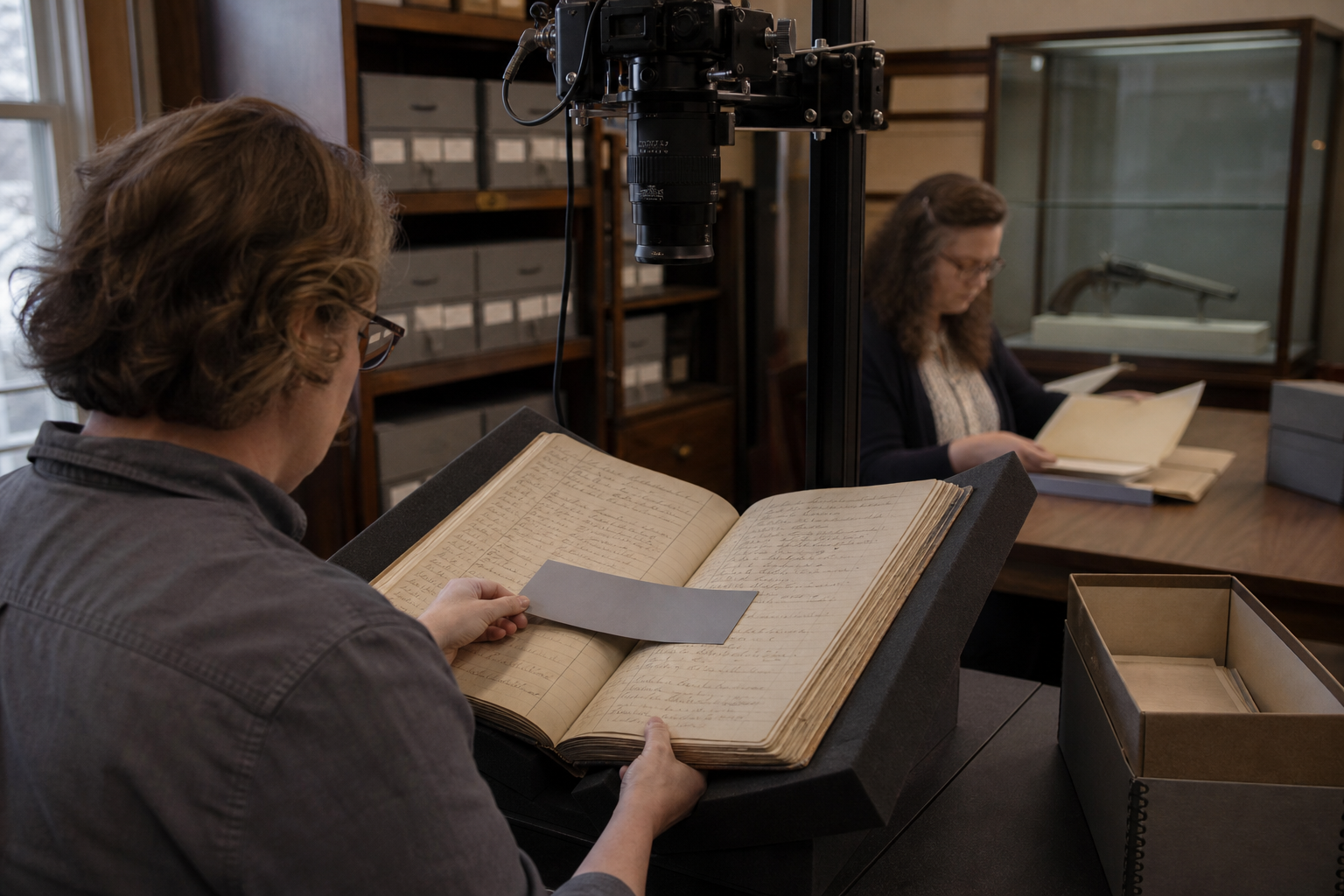
Public access can use a second file. In the scene shown here, the overhead camera records the ledger on its cradle while a removable mask covers one line in the access image. No adhesive touches the page, no digital screen appears in the photograph, and the secured museum object stays in the background. The method is visible because the article's central claim is visible: access can be narrowed without rewriting the evidence.
The Library of Congress overview of archival description notes that archives create inventories, registers, indexes, and guides for collections of primary sources. A useful public record can therefore describe the shop, date range, creator, physical form, and research significance without transcribing every customer entry. Description provides a route to the collection; it does not have to reproduce the collection line by line.
Context also belongs outside the image. Record whether the ledger came with shop papers, from a family, or from another repository. Keep the capture date, file checksum, and access restriction together. If the public copy was masked or cropped, say so and link it to the unaltered master.
Uncertainty belongs in the catalog
A careful description separates observation from inference. “Ledger headed with the shop name and dated 1924” describes visible evidence. “The shop served the entire county” is an interpretation that would need broader support. “Believed to record work for a family-owned revolver” may preserve useful donor context, but the wording must remain attributed until another record confirms it. Qualifiers are not weak writing; they are part of an honest chain of evidence.
Access restrictions should be explicit. The Smithsonian Institution Archives collections access policy shows that broad research access can coexist with limits protecting privacy or donor terms. Record why a line is withheld, who may review the master, and when the decision should be reconsidered. A restriction without a reason can be as misleading as unrestricted publication.
This approach also complements the site's earlier note on reading a complete gunsmith-shop photograph without overclaiming. A photograph and a ledger answer different questions, and neither should be forced to carry the other record's missing facts. Used together, they can locate a room, a period, and a business relationship while keeping the boundary between evidence and story visible.
A trustworthy archive does not make an old ledger cleaner than it was. It keeps the complete record, limits unnecessary exposure, and describes what survives precisely. That is how customer names become responsible business history instead of uncontrolled disclosure.